Does soup count as fluid on a fluid limit?
What kidney, dialysis and heart failure patient guidance says about soup, ice, gelatin, ice cream, fruit and drinks taken with medicines, and where the sources differ.
Quick answer
Does soup count as fluid on a fluid limit?
- Several patient guides count soup as fluid on a fluid limit. Cleveland Clinic's heart failure guidance lists soup, thick or thin, as a fluid [1]. NIDDK hemodialysis guidance also counts soup [2]. Kidney Care UK says fluid foods such as soup sometimes need to be included [3]. One NHS leaflet counts high-fluid foods as half fluid [4].
Stop guessing. Start counting.
Vari logs fluid and salt and keeps the record for you.
Get The App Free →Free on iPhone
- Free to start
- 30 days of history free
- Syncs with Apple Health
Built for iPhone · Apple Health sync · Privacy-first
If you live with kidney disease, are on dialysis or live with heart failure and are on a fluid limit, the question of what counts as fluid comes up quickly. Drinks are the obvious part, but soup, ice, gelatin and ice cream raise questions too. The guidance below comes from kidney, dialysis and heart failure patient materials. The sources agree on a lot, but they draw some lines differently, so this page reports what each one says rather than giving a single rule. Your own limit, and what it includes, is set with your doctor, nurse or dietitian [4][2]. Cleveland Clinic says that if you are not sure whether something is a fluid, ask your doctor or nurse [1].
What each source counts as fluid
Cleveland Clinic heart failure guidance counts all foods that are liquid at room temperature, plus pudding, gelatin, soup, ice pops, ice cubes and ice cream.
Its heart failure guidance lists pudding, gelatin (Jell-O), soup (thick or thin), Popsicles, ice cubes and ice cream as fluids, alongside foods that are liquid at room temperature [1].
Source: [1]
NIDDK hemodialysis guidance counts foods that are liquid at room temperature and foods with a lot of liquid in the recipe.
It names soup as a food that contains water, and says gelatin, pudding, ice cream and other foods that include a lot of liquid in the recipe also count [2].
Source: [2]
Kidney Care UK counts any liquid that is drunk, including liquids taken with medications.
It says fluid foods such as soup, gravy, yogurt, custard and jelly sometimes also need to be included, and that solid foods are not counted [3].
Source: [3]
A Kidney Care UK page written with a kidney dietitian says it is not just drinks that need to be considered.
It names milk on cereal, jelly, yogurts, gravy, soup and ice cream as having a high water content that really does need to be included [5].
Source: [5]
A West Suffolk NHS Foundation Trust dietetics leaflet counts all drinks and any food that is liquid or melts.
Its drinks list includes tea, coffee, juice, squash, milk, supplement drinks, milk on cereal, ice cubes and drinks taken with medications [4]. Its foods list includes soup, gravy, sauces, custard, ice cream, sorbet, yogurt, milk puddings and jelly [4].
Source: [4]
Where the sources draw the line differently
Counting some foods as half
The West Suffolk leaflet says to count foods with high fluid content as half fluid, and says solid foods do not need to be counted [4]. The other sources listed here do not describe a half rule.
Fruit and vegetables
NIDDK hemodialysis guidance says most fruits and vegetables contain water, such as melons, grapes, apples, oranges, tomatoes, lettuce and celery, and says to count these foods when adding up the day's liquid [2]. Kidney Care UK, by contrast, says solid foods are not counted [3].
Soup and other fluid foods
Cleveland Clinic and NIDDK list soup as a fluid without qualification [1][2]. Kidney Care UK says fluid foods such as soup sometimes need to be included [3].
Cooking water
The West Suffolk leaflet says the water used to cook pasta or rice does not need to be counted [4].
Ice cubes
Cleveland Clinic and the West Suffolk leaflet both list ice cubes as fluid [1][4]. The West Suffolk leaflet suggests counting each ice cube as 15 ml [4].
How people measure their own cups and mugs
- Kidney Care UK describes measuring how much your favorite cup, mug or glass holds, so each drink can be added up [3].
- The West Suffolk leaflet gives typical volumes for adding up fluid, including an average teacup at 150 to 200 ml, an average mug at 300 ml, a can of drink at 330 ml, a bottle of water at 500 ml and a portion of soup at 200 ml [4]. These are typical container sizes, not amounts to drink; your own limit is set with your clinician.
- The same leaflet lists milk on cereal at 150 ml, milk on porridge at 250 ml, and one tablespoon of sauce or one ice cube at 15 to 30 ml [4].
- Kidney Care UK describes measuring the day's fluid allowance into a jug in the morning and taking away the same amount each time something is drunk, so the remaining amount stays visible [3].
- Cleveland Clinic describes marking a limit on a 2-liter bottle, filling it to the mark each morning, and emptying the same amount each time a fluid is taken [1].
- Cleveland Clinic also mentions keeping a daily log of fluids on paper or with an app on a phone or computer [1]. The National Kidney Foundation says some dialysis patients use a container they can mark, or keep a journal of every liquid each day [6].
Every fluid limit is personal
Allowances differ from person to person
Kidney Care UK says a person's fluid allowance depends on factors such as dialysis, blood pressure, weight and urine production, and that everyone's allowance is different [3][5]. It adds that a personal limit can vary with activity, temperature and the amount of urine passed [5].
Who confirms what counts
Kidney Care UK advises checking with your kidney team before following its fluid advice, because cutting back on fluid without being advised to may cause harm [3].
Not guided by other patients
The West Suffolk leaflet says fluid intake is individual, so not to be guided by other patients, and that your doctor should guide the daily amount [4]. NIDDK describes working with a renal dietitian to set a daily liquid goal [2].
Not every heart failure plan includes a limit
UK NICE guidance says not to routinely advise people with heart failure to restrict their sodium or fluid consumption, so not everyone with heart failure is on a fluid limit [7].
How Vari fits in
Your units, your limit
Vari is an iPhone app that records fluids and salt. You set a fluid target as an "at most" limit in ml, L, fl oz or cups. Vari never suggests, calculates or changes a target; it comes from you or your care team.
You decide what to log
Vari does not decide what counts as fluid. You log what you and your care team agree should count, whether that is a drink, a bowl of soup or a measured portion.
Presets for your own cup
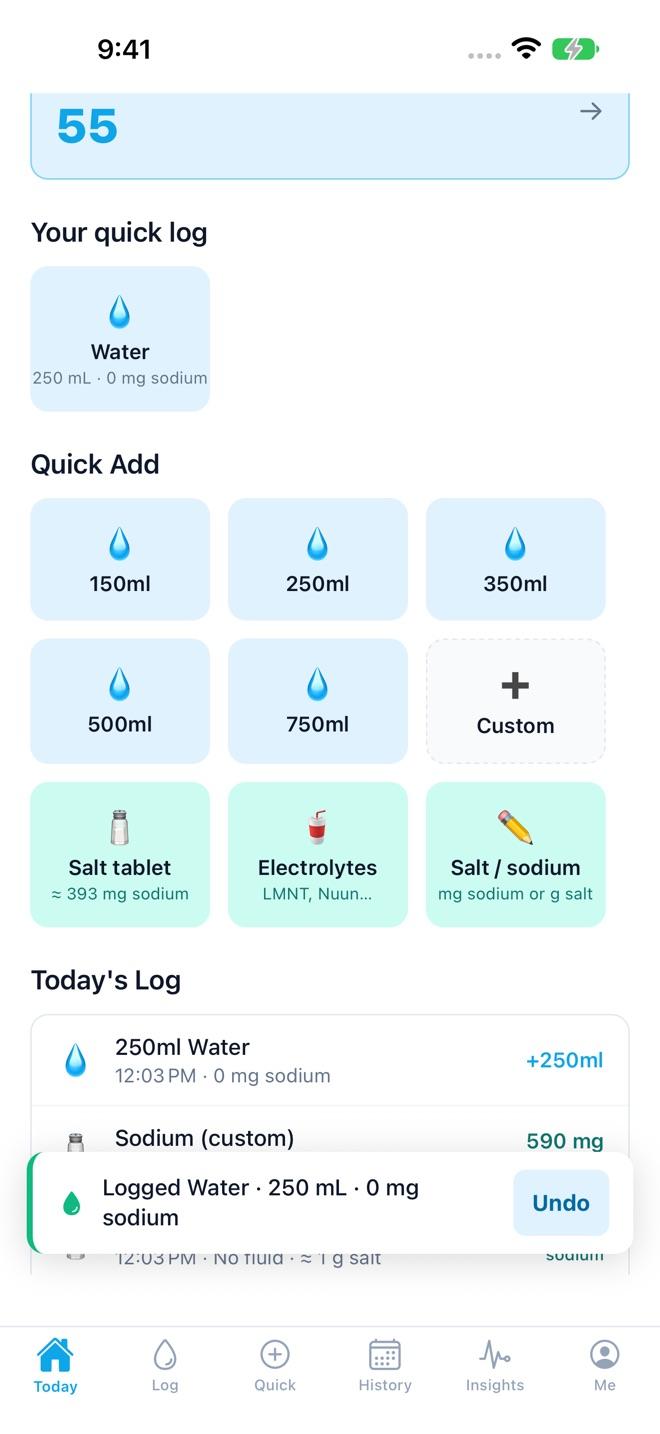
Once you know what your mug or glass holds, you can save it as a preset in the quick-log row, and undo an entry if you tap the wrong one.
Room left under the limit
Today shows one indicator for fluid: how much room is left under your "at most" limit. An "at most" limit is never scored as a goal, and Vari never nudges anyone towards more fluid.
Records to share
Premium keeps your whole history, adds insights calculated from what you logged, and lets you export entries as a CSV file to share with a healthcare professional. With permission, the drinks you log are saved to Apple Health as water.
Keep a clear record against your own limit
Record fluids and salt in Vari, in your own units, against the targets you and your care team set. Logging and your own targets are free.
Download VariMedical Disclaimer: Vari records the fluids and salt you log against targets you and your care team set. This page shares published information; it is not medical advice. Talk to your clinician before changing what you drink or how much salt you take.
Sources
Sources were fetched and checked on 18 November 2026. Numbers in brackets refer to this list.
- 15 ml — The West Suffolk NHS leaflet suggests counting each ice cube as this amount of fluid.[4]
- 200 ml — The West Suffolk NHS leaflet gives this typical volume for a portion of soup.[4]
- 1/2 — The West Suffolk NHS leaflet counts foods with high fluid content as this fraction of fluid.[4]
- 100 ml — Kidney Care UK notes that using a teacup instead of a mug saves up to this much per drink.[5]
- UK NICE guidance says not to routinely advise people with heart failure to restrict sodium or fluid consumption.[7]
- [1]Cleveland Clinic: Heart failure, limiting sodium and fluids — Cleveland Clinic: Heart failure, limiting sodium and fluids. my.clevelandclinic.org. Accessed 2026-11-18.my.clevelandclinic.org
- [2]NIDDK: Eating and nutrition for hemodialysis — NIDDK: Eating and nutrition for hemodialysis. niddk.nih.gov. Accessed 2026-11-18.niddk.nih.gov
- [3]Kidney Care UK: Managing your fluid levels — Kidney Care UK: Managing your fluid levels. kidneycareuk.org. Accessed 2026-11-18.kidneycareuk.org
- [4]West Suffolk NHS Foundation Trust: A guide to fluid restriction — West Suffolk NHS Foundation Trust: A guide to fluid restriction. wsh.nhs.uk. Accessed 2026-11-18.wsh.nhs.uk
- [5]Kidney Care UK: Quenching thirst — Kidney Care UK: Quenching thirst. kidneycareuk.org. Accessed 2026-11-18.kidneycareuk.org
- [6]National Kidney Foundation: Fluid overload in dialysis — National Kidney Foundation: Fluid overload in dialysis. kidney.org. Accessed 2026-11-18.kidney.org
- [7]NICE NG106: Chronic heart failure in adults — NICE NG106: Chronic heart failure in adults. nice.org.uk. Accessed 2026-11-18.nice.org.uk
Last reviewed: 2026-11-24. Every figure on this page is sourced to the named primary references above.
Want to stop guessing?
- ✓Log fluid and salt in two taps
- ✓Today shows where you are
- ✓CSV export (Premium)
Frequently Asked Questions
Does ice count toward a fluid limit?
Cleveland Clinic's heart failure guidance and the West Suffolk NHS leaflet both list ice cubes as fluid [1][4]. The West Suffolk leaflet suggests counting each ice cube as 15 ml [4]. Your care team can confirm what your own limit includes.
Do fruits and vegetables count as fluid?
Sources differ. NIDDK hemodialysis guidance says to count fruits and vegetables that contain water, such as melons, grapes, oranges, tomatoes and lettuce [2]. Kidney Care UK says solid foods are not counted [3], and the West Suffolk leaflet says solid foods do not need to be counted [4]. Cleveland Clinic suggests asking your doctor or nurse when unsure [1].
Do drinks taken with medicines count?
Kidney Care UK says any liquid that is drunk, including liquids taken with medications, counts as fluid [3]. The West Suffolk leaflet also lists drinks taken with medications [4].
Does everyone with heart failure need to count fluids?
No. UK NICE guidance says not to routinely advise people with heart failure to restrict their sodium or fluid consumption, which means not everyone with heart failure is on a fluid limit [7]. Whether a limit applies to you is a decision for your clinician.
How do people work out how much their cup holds?
Kidney Care UK describes measuring how much a favorite cup, mug or glass holds [3]. The West Suffolk leaflet gives typical volumes, such as about 300 ml for an average mug and 150 to 200 ml for an average teacup [4].
Does Vari decide what counts as fluid?
No. Vari records the drinks and other entries you choose to log, in your own units, against a limit you and your care team set. It does not decide what counts, and it never sets, suggests or changes a limit.
You don't need to track this by hand.
Apple Health synced, computed on your iPhone
- ✓Two-tap logging
- ✓Reminders you set
- ✓CSV export (Premium)
Free to start · Premium: $2.08 a month, billed annually at $24.99 · iOS 16.4+